Semester Abroad
Paderno Del Grappa
by G. Mauricio Rivero

Contents
 |
Experience the World |
|
Spring Semester General Information |
|
Campus |
|
Italy: traveler's information |
|
Visa Information |
|
Some Useful Terms to know... |
|
Italian Passion |
|
Nightlife and Hot Spots |
Experience
the World….
By
G. Mauricio Rivero
University of Arkansas
A lot of things have been said about the opportunity of studying abroad during our college years and beyond. Indeed, several implications may arise. I am referring to the different feelings and viewpoints that may overcome our senses, as well as different reactions and opinions from everyone’s unique personalities and perceptions. As a result, I’ve grasped from my very own personal experience, that there is only one way to build up your personality and to enhance your own self image, as a person and as a citizen of your own country, and that is to experience different cultures, different kinds of people, places and situations and to get away from mom’s lap for a while!
Moreover, you may read all the books you want, or watch all the
movies or documentaries, or hear a bundle of stories, learn several languages in
a classroom, and so on, but you’ll never, ever be able to grasp and completely
understand or “taste” what’s outside our boundaries if you don’t
experience it by yourself. Indeed,
you might have taken Spanish, French or German, and may think you’re actually
familiar with that language, but believe me, you’ll be totally lost when you
go to a place where people speak with their own slang and they do it to the
speed of light!
In addition, when it comes to our careers, studying abroad gives
us an opportunity to have a very useful complementary tool that will let us
“sculpt” our career options and also, it represents a hands-on real life
opportunity to broaden our knowledge. Hey,
besides, it wouldn’t look too bad in a resume at all, would it?
Anyhow, I just want you all to have an additional perspective of what we’ve heard so far. Also, to have a little web site where we can express ourselves, to acquire some more resources and feedback, and to match some of our mutual needs and interests to what it’s meant to be “the experience of a lifetime”.
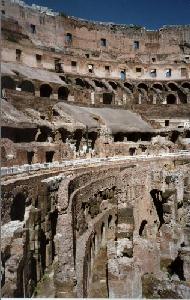
Spring
Semester General Information:
This is a unique business program created by the Consortium of Universities for International Business Studies. It’s being offered for the first time this upcoming Spring 2000 and despite the relatively short notice and uncertainty, it has gathered so far, an interesting number of students from several universities across the country.
This first program is scheduled from January 26 through May 6, 2000. In addition, under this program, undergraduates select up to 18 hours of coursework from a variety of business topics and other classes delivered in English.
The faculty: Professors are drawn from the Consortium’s member universities. Faculty is recognized as excellent business education professionals with a bundle of experience in teaching, development and business research.
Business courses primarily offered:
| Marketing |
| Management Science-Operations Management |
| Finance |
| Organizational Behavior-Principles of Management |
| Strategic Management |
| Advanced Managerial Accounting |
| Legal Aspects of International Business |
| Global Marketing |
| International Finance |
| Global Entrepreneurship |
| Global Operations Management |
| Business Logistics |
| International New Venture Development |
| International Negotiations |
| International Macro Economic Analysis |
| Seminar in European Business |
| Advanced Management Information Systems |
Non-business courses:
| Italian I and II |
| German I and II |
| European Studies |
| European Art History |
| International Political Economy |
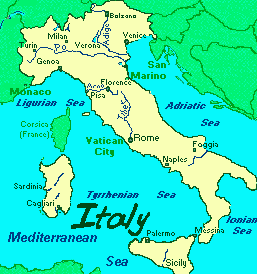
Note: This program has been created taking into consideration that it’s not a usual school term. Indeed, classes are scheduled in such a way as to encourage travel opportunities for students. Weekend visits to France, Germany, Switzerland, Austria, and most of Italy and Europe are planned from Venice’s rail connections.
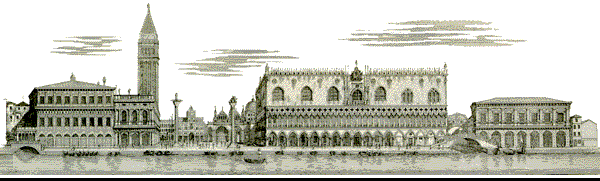
Venice
Campus:
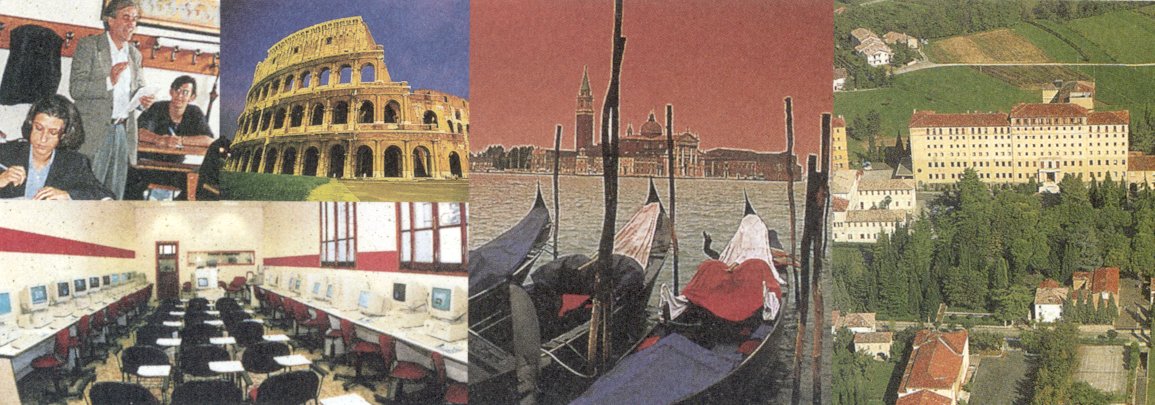
Location: The campus that we’ll attend is located in Paderno Del Grappa, in the Veneto region, north of Venice, Italy. This pictorial location is nestled in the foothills of the Dolomite Mountains. Also, if you don’t know how to ski, get ready because the campus is less that one hour from ski slopes.
Facilities: The campus has all necessary facilities like: athletic and recreational facilities (such as tennis courts, swimming pool, basketball arena, soccer fields and weight rooms), classrooms, theatre, computer labs, dormitories, cafeteria, huge gardens and other amenities.
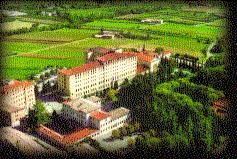
Paderno
Italy: traveler’s information
Time Zone
| Italy is in the Central European time zone. |
| Daylight Savings Time (+ 1 hour) is in force from the end of March until the end of September, as in almost all European countries. |
Customs and Currency Regulations
| There are no limits on importing lire or other currencies. Exporting currency from Italy is free up to a maximum of 20 million lire or the equivalent in foreign currency. Customs authorization is required for higher sums. |
| Italian currency in circulation consists of coins of 5, 10, 20, 50, 100, 200, and 500 lire and banknotes of 1,000, 2,000, 5,000, 10,000, 50,000 and 100,000 lire. |
| The Italian
customs authorities allow duty-free importation of the following articles
(for non-commercial reasons and subject to declaration at the frontier): 200
cigarettes or 100 small cigars or 50 cigars or 250 gr. of loose tobacco: 1
liter of alcohol over 22 degrees or 2 liters of alcohol under 22 degrees; 2
liters of wine; 50 cc of perfume; 500 gr. of coffee. |
| In addition to
personal effects, visitors are also allowed to bring in jewelry, two
cameras, one video camera, one radio, one television, one tape recorder, one
bicycle, one boat (with or without motor), two pairs of skis, two tennis
rackets, one canoe, one surf board. These limits apply only to non-EU
citizens. |
Particular Traffic Regulations
| Speed limits are fixed at 50 km/h in urban areas, 110 km/h on main roads outside urban areas, 90 km/h on secondary and local roads and 130 km/h on motorways. |
| The new Highway Code, recently introduced in Italy, following EC directives also stipulates that one must not drive at a speed, which is so slow as to hinder the flow of traffic. |
| There are speed limits of 80 km/h on all roads outside urban areas and 100 km/h on motorways for cars towing trailers or caravans. |
| The wearing of seat belts in front and rear seats is obligatory. An appropriate harness system, taking account of height and weight, is obligatory for children from 3 to 12 years of age and less than one and a half meters tall. |
| The wearing of a helmet is obligatory on two wheeled vehicles. |
| The flashing of headlights is permitted to signal an intention to overtake. The vehicle being overtaken must facilitate the maneuver and not accelerate. In cities the use of dipped headlights is allowed on all vehicles. |
| Finally, it should be noted that, because of air pollution, the authorities in large cities might restrict the movement of motor traffic. |
Means of Transportation
| Italy functions as a crossroads for Mediterranean air routes. Alitalia and other domestic airlines provide daily links between the Italian airports. |
| The rail network is adequately developed and widespread, especially between major urban centers and tourist areas. In recent years rail transport has experienced numerous technical innovations, which have led to greater efficiency and speed. |
| Rail ferry services, carrying cars, depart from Civitavecchia (Rome) and Villa San Giovanni (Reggio di Calabria) providing access to Sicily and Sardinia. |
| Special tariffs are available for tourists (information in travel agencies and railway stations). Note that train tickets must be stamped, before the journey, using the special machines provided in the stations. |
| Car ferries and hydrofoils link the mainland with the two main islands, the Tuscan and Campania Archipelagos, the Aeolian Islands, Ustica, the Egadi Islands, the Pelagie Islands and Pantelleria. Regular shipping services operate on the pre-Alpine lakes (Maggiore, Como, Garda, Iseo). |
| There are bus, tram, trolleybus and taxi services in the cities. Rome, Milan, Naples and Genoa also have underground railways. |
| The
main international car hire companies have branches all over the country. |
Visa
Information:
Italian
Embassy Website (click here)
Passport Visa Regulations
As of October 27, 1997, the Embassies and the
Consulates of Italy can issue Schengen visas to alien residents, which will
allow them to visit the following European countries: Belgium, France, Germany,
Greece, Italy, Luxemburg, Netherlands, Portugal, Spain.
Non-U.S. Citizens
Non U.S. citizens should check current visa
requirements with the competent Italian Consulate before departure. (See list of
the Consulates and their jurisdictions).
Citizens of countries who need a visa to travel on
business or as a tourist to the Schengen countries mentioned above, may receive
a visa for a short stay of 1 to 90 days (per semester).
If the person intends to visit only one Schengen
country he/she must apply for a visa at the Embassy or the Consulate of that
country.
If the person intends to visit several Schengen
countries he/she must apply for a visa at the Embassy or the Consulate of the
country in which the main destination is situated.
If the person intends to visit several Schengen
countries but does not have a main destination, he/she should apply for a visa
at the Embassy or the Consulate of the country, which is the first point of
entry, or the first country that requires a visa.
U.S. Citizens
U.S. citizens, traveling as tourists, do not need a
visa for up to 90 days (within the Schengen area per each semester). Their
passport must be valid 3 months beyond the date of return to the U.S.
U.S. citizens wishing to remain in Italy for more
than 90 days and/or for reasons other than tourism, need a visa. In this case,
please contact the competent Italian Consulate before leaving the United States.
For all Foreign Citizens
Every foreign citizen within 8 days upon arrival in Italy has to register his or her presence at the local Police Authority (Questura) in order to receive the 'Residence Permit' (permesso di soggiorno), which is the only legal document that can legitimize the stay of a foreign citizen in Italy.
Some
useful terms to know….
| Salve: hello |
| Addio: goodbye |
| Ella: she |
| Egli: he |
| Grazie: thank you |
| Ciao: hello, goodbye (familiar) |
| Spiacente: I’m sorry |
| Signore: sir, mister |
| Signora: Madame, Mrs. |
| Signorina: miss |
Nouns:
| La cucina: kitchen |
| La casa: house |
| Il bagno: bathroom |
| La stanza: room |
| Il tavolo: table |
| La porta: door |
| La sedia: chair |
| Il telefono: telephone |
| La finestra: window |
Adjectives:
| Antipatico(-a): unpleasant |
| Carino(-a): pretty |
| Contento(-a): happy |
| Malato(-a): sick, ill |
| Brutto(-a): ugly |
| Simpatico(-a): sympathetic |
| Sporco(-a): dirty |
Colors:
| Bianco: white |
| Arancione: orange |
| Rosa: pink |
| Giallo: yellow |
| Azzurro: blue |
| Rosso: red |
| Verde: green |
| Nero: black |
Numbers:
| 0 zero |
| 1 uno |
| 2 due |
| 3 tre |
| 4 quattro |
| 5 cinque |
| 6 sei |
| 7 sette |
| 8 otto |
| 9 nove |
| 10 dieci |
The Italian Passion
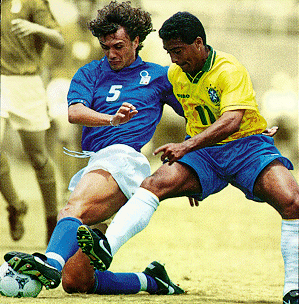
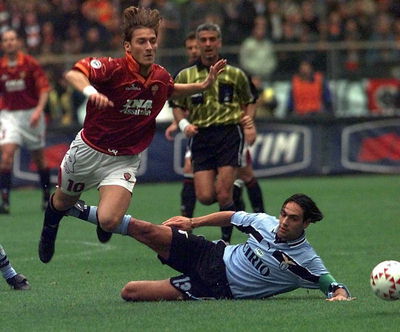
As you may know by now, American football, basketball and baseball are not major “thrills” in Europe. Italy is not an exception. It’s just that Italians go crazy for their “football”, or so called Calcio Italiano, which is the Italian soccer league. Moreover, they have a reason for that. Italy’s national team is very prestigious and extremely competitive worldwide. Indeed, they are 2-times world cup champions, several times European champions, and if that’s not enough, their professional league is considered to be the most powerful, influential and respected in the planet. I guarantee that there’s not one pro-player in any international league that would dare to reject an offer to play in Italy.
In addition, at the time of the program, several soccer events will take place: the EuroCup 2000, played in major cities within Europe, World Cup qualifiers and the “Italian Calcio Serie A”, which is the top professional league in Italy and it’s played in every major city in the country. For additional info about dates and locations, go to FIFA.com
So, if you want to see in action the best football (soccer) players in the world, you are going to be at the right place and hopefully, at the right time.
Here are some links to the “Italian madness”:
Nightlife
and hot spots:
Let’s have fun!
Italian youth is somehow different. Italians are known to
be liberal and very open-minded. But they know how to have fun too….
I found some links to the hottest nightclubs in Italy and other cool things to do while traveling around Europe.
For any comments, questions or suggestions, click here…
Selected student entries:
| not available yet |